Women’s Waste Management Project
Women Unlimited in partnership with Eswatini Environment Authority with support from UNDP through Catalyze implemented a waste for livelihoods initiative focused on bottle recycling to improve livelihoods of vulnerable women and youth in Mpolonjeni, Mahwalala.
The project recruited 31 waste collectors (21 women and 7 youth and 3 men) who were trained in waste collection and bottle recycling. The Project has set up a glass sorting and recycling centre complete with glass crusher machine and facility for processing both coloured and clear glass. The recycling site is complete and fully commissioned with temporary shelter, electricity, water tank and glass crusher. The beneficiary group has now been formally incorporated as a company called; Waste Life Investments and will now be expected to take up the project as it begins to be profitable. However, Women Unlimited is not completely withdrawing her mentorship and support, we will continue to guide and provide project oversight to Waste Life Investments towards the same. As an Organisation, we also anticipate to build upon this initiative for future interventions and continue to expand the project.
Land for the project site was Acquired from the Mpolonjeni Chief Zembe Dvuba. The land will also be used to setup decorative concrete molding from coloured glass. The glass sand will be used as a course or fine aggregate, or as a partial cement substitute in a wide range of concrete-based products namely: Floor and wall tiles; Tombstones; Table counter tops; Benches; Vanity counters; Decorative cement pots and Garden Furniture.
Women Unlimited activities contributed to the establishment of the newly established company; Waste Life Investments which has moved from an unstructured group of waste collectors , struggling to make ends meet, to company directors and shareholders with their own business run and manage! In total 17 women and youth have made it to the end and benefited from the initiative out of the initial 31 that were initially recruited. The group is now fully operational and looking into more markets and opportunities in waste management.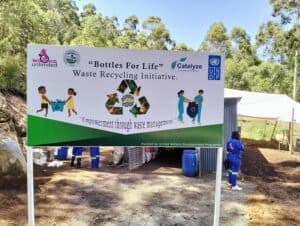
Eswatini Zero Plastic Contamination Initiative
Women Unlimited in collaboration with the Eswatini Environment Authority, with support from UNDP under the GEF Small Grants Programme is currently implementing a waste management project to motivate for the ban/levy on non- bio degradable plastics in Eswatini by end of year 2023 , covering plastic production, consumption and disposal.This Initiative is targeting Legislators, Policy Makers, Government Ministries, Parastatals, Local Authorities, Academia, Plastic Industry, Recycling Companies and 200 vulnerable Women and Youth in Communities with target areas being peri-urban communities in the Kwaluseni Inkundla.
Women Unlimited hosted an inception meeting reaching over 30 key stakeholders and engaging over 10 industry stakeholders on considerations for non- bio degradable additives in plastic manufacture . The organisation conducted a baseline survey on plastic waste policy, manufacture , distribution and disposal. We hosted Eswatini’s first ever Waste Convention- Waste Indaba with EEA and the Ministry of Tourism and Environment Affairs. So far the Project has reached over 20 000 citizens through national radio with education and awareness on the hazards of plastic waste and motivations for plastic waste management. About 5000 citizens were reached through UNESWA community radio and a dialogue was initiated with about 60 policy makers in the country on the pros and cons of banning single use plastics and the development of a National Action Plan.
FCDO – “Supporting life-saving multi-sectoral interventions responding to the impact of climate shocks on children in Southern Africa” – Eswatini, Lesotho and Madagascar
In 2021, Women Unlimited in collaboration with Swaziland Action Group Against Abuse (SWAGAA), Royal Eswatini Police Services (REPS), Ministry of Education, and Department of Social Welfare with support from UK AID, Foreign, Commonwealth and Development Office (FCDO) and UNICEF implemented this project to ensure that children and adolescents are protected from violence and HIV, learning and equipped with the skills to become active citizens by year 2025.
The project targeted the Shiselweni and Northern Hhohho (Buhleni) regions of Eswatini mainly in areas including; Gege, Magubheleni, Mashobeni,Siyendle,Kaphunga,Kakholwane, Mpompotha, Mhlangatane,Vusweni and Hhelehhele. Project Activities reached over 20, 000 Women and children with increased coverage and access to quality Gender Based Violence (GBV) and Violence Against Children (VAC) prevention, risk mitigation and response services in selected regions.
A total of 20,436 women, men and children were reached with both services and VAC/GBV information , through a mix of community dialogues , school dialogues and virtual TV dialogues. 4,582 received walk-in and remote response services. A total of 448 children with disabilities were reached with prevention and sensitization messages.
Women Unlimited activities contributed to an increased coverage and access to quality GBV and VAC prevention and response services. Activities reached over 2000 vulnerable women and children in remote rural communities that suffer from lack of access to quality response and prevention services on GBV. Sexual Abuse can contribute to a lot of physical , health and emotional trauma. It affects in particular a female’s potential career. GBV ‘kills’ confidence and affects opportunities for women in development or substantial career and jeopardizes educational opportunities or livelihood potential for women. Women Unlimited delivered critical empowerment to vulnerable women and children focusing on such issues including understanding the SODVA 2018, ‘pimping’, sex Trafficking and exposure to pornographic material. More than 60% of participants reported improved knowledge of the four forms of GBV (emotional , physical, sexual and financial) and greater willingness to report or prevent violence against children.
Amplifying Women’s voices in Peacemaking processes in Eswatini
In 2022, Women Unlimited in collaboration with Liphimbo Labomake and various Women led CSOs, Deputy Prime Minister’s Office (DPMO) Gender Unit and Cordaid with support from Women’s Peace and Humanitarian Fund (WPHF) implemented this project nationally with the aim to amplify women’s voices in peace making processes in Eswatini.
Eswatini has a dual system working in parallel. Besides Roman Dutch Law, there is the traditional Swazi Customary law which can be very oppressive to women and girls’ rights. According to old Swazi Customs, Women in a marital relationship are treated as minors under the care of their husband or male relatives.The Swazi society is deeply entrenched in patriarchy with little to no spaces for women in leadership positions across the divide.These were the prevailing conditions in the country as the project was implemented.The project thus sought to strengthen the negotiation skills of human rights defenders to ensure women’s voices are represented in decision-making. The programme reached over 30 CSOs, 10 communities, and hosted 225 women CSO leaders in trainings and engagements of CSOs, political parties and trade union. The total reach via trainings, community engagements, civic education, distribution of educational material and a community radio was 11,473. Over 60 000 people were reached via a social media and media campaign.
The project successfully amplified and coordinated the voices of women in the peacebuilding process; provided civic education and awareness to thousands of citizens; and build the capacity of both implementing partners and women’s coalition members and women-led CSO leaders on national peace-making, conflict management and negotiation. In the implementation of our activities, the team took a human rights approach, ensuring to support arguments made for women’s equal participation with constitutional considerations. This had an immense impact on the women who initially saw many of the gender discrimination which typically prevents or hampers their participation as something backed by law, which is not the case. It also gave a base for women to claim their rights to equally participate without discrimination in their communities and beyond about gender equity across all four regions of the country.
At the culmination of the project women were able to conduct a SWOT analysis of their ability to influence the road towards an inclusive dialogue, and the current decision-making and impact status within their various institutions before subsequently producing action plans towards increasing their impact and engagement in these spaces. An action plan on how women can also push for the adoption of the UNSCR 1325 was also generated. These key documents will be carried forward as part of a sustainability plan to carry forward the work started during the implementation of the project.
Our engagements of women resulted in a resounding call for an increase in platforms for women to hold conversations on the subjects presented by the project, deepen their knowledge on peacebuilding, their rights and the constitution, selection and capacity building of women in the communities to champion this cause, and capacity building on leadership skills. Women want to engage in peacebuilding and desire to have representatives from among them who could be adequately prepared to represent them when carrying out peacebuilding efforts. Alongside disparities in knowledge on the political conflict, the project uncovered glaring gaps in women’s engagement in decision-making even on the home front. Here, reliance on male counterparts, gendered hierarchies in everyday societal life, and fears of discrimination were cited as major hinderances to women’s participation. However, the eagerness to carry the peacebuilding agenda forward and great appreciation for the knowledge gained throughout the project is evidence of the immense work put forward through this project and the hope that women will continue to push for peace. We believe the strides made during the implementation of the project have paved the way to engage in continued peace building.
A stronger more resilient women’s movement has emerged in Eswatini and the recommendations and demands formulated will form the basis of women’s engagement and involvement in peace issues for a long time in Eswatini.Six (6) positions were drawn on women’s demands for peaceful engagement in Eswatini and 1 joint statement with Lipimbo Labomake.
Eswatini GBV Crisis Initiative
Women Unlimited collaborating with African Women’s Peace and Development Foundation, SWAGAA and Liphimbo Labomake (AWPDF) with support from Urgent Action Fund Africa implemented a national project to seek increased collaboration , resource allocation and support from government and CSOs towards ending GBV and Femicide in Eswatini.
The data presented by our Baseline during this project, showed that GBV is a major social problem faced by Eswatini as such it should be declared a state of emergency. The data showed that more females than males are victims of both physical and sexual abuse while emotional abuse seems to be higher in males and young people. The data showed the gravity of a social problem and presented opportunities for policy transformation and quality GBV response and prevention services.
A well co-ordinated GBV response service between Royal Eswatini Police, DPMO Gender Unit and the Ministry of Justice which would result in improved justice delivery for women survivors of GBV and to reduce the present extended suffering and waiting.The action sought to increase stakeholder awareness on the current GBV crisis and help build momentum and support for policy change. Strengthened service provision by the implementing partners and help women access quality GBV response and support services, thereby improving the enjoyment of their right to quality health services. Other partners leading the coalition are Liphimbo Labomake who helped mobilise the women movement and SWAGAA whose role in the project was to spearhead policy change advocacy efforts towards legislators in parliament and the senate.
AWPDF helped mobilise other CSOs to participate in the action’s activities and develop collaborative synergies with Royal Eswatini Police Service and the Ministry of Justice towards improved GBV prevention and response services. The Deputy Prime Minister’s office Gender Unit were an invaluable collaborating partner in this action as custodians of Gender Issues in the country. Their role was to mobilise other government Ministries and officials to participate in the program as well as assist in engaging the Prime Minister’s office as the supreme policy change office in the country.
The kingdom of Eswatini is characterised as a patriarchal society, where men possess all the power and this results in power imbalance. Culture also plays a vital role in promoting GBV, Inequality and financial instability in women among others. The project was conceptualized to address the growing concern about the escalating incidence of violence against women and girls (VAWG) and the level of femicide in the country Women Unlimited together with African Women’s Peace and Development Foundation (AWPDF) and other concerned stakeholders have held a consultative seminar to address this scourge and have called for the declaration of Gender-Based Violence (GBV) as a national emergency.
The impact of the project activities were shown by the buy in of the members of parliament for GBV emergency declaration as it is likely to get government to listen and treat the matter seriously or to eventually declare GBV a national emergency. Government conducted a review of the National Strategy on GBV set to be finalised and published. The previous strategy was expiring in 2022 which was a major contention in our urgent initiative and project goal. More stakeholders have been mobilised for the GBV emergency agenda and have joined the campaign and call for declaration including UN Agencies such as UNAIDS. Members of Parliament have adopted the declaration agenda and committed to table the request before the house and senate, the GBV baseline was successfully concluded and provided data for our advocacy and awareness campaigns and more than 20 CSOs have been mobilised to rally support for the GBV crisis declaration thereby strengthening the GBV women’s movement.The buy in of the members of parliament for GBV emergency declaration is the most significant success story as it is likely to get government to listen and treat the matter seriously or to eventually declare GBV a national emergency.